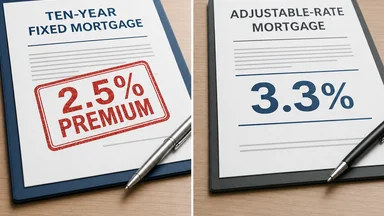
In 2016, mortgage rates were near historic lows. The ten-year Treasury yield hovered around 1.8%, and lenders offered competitive fixed-rate products. For a borrower taking out a $300,000 loan, a ten-year fixed mortgage at roughly 5.8% meant a monthly payment about $350 higher than a five-year adjustable-rate mortgage (ARM) at around 3.3%. That premium—roughly 250 basis points—was the price of certainty. But as the Federal Reserve raised rates aggressively after 2021, borrowers who chose the fixed product found themselves locked into a rate they could no longer refinance away from. This is the story of that bet, and how it played out for millions of homeowners.
The 2.5% Gap That Changed Millions of Monthly Payments
The gap between a ten-year fixed mortgage and a five-year ARM in 2016 was stark. On a $300,000 loan, the fixed-rate borrower paid roughly $1,760 per month (principal and interest), while the ARM borrower paid about $1,310. That $450 difference—2.5 percentage points—was the premium for rate stability. For many, it seemed like a small price to pay for peace of mind, especially after the housing crisis of 2008, when adjustable-rate mortgages had devastated homeowners.
But the premium was not trivial. Over five years, the fixed-rate borrower paid roughly $27,000 more than the ARM borrower. If rates had stayed low, the ARM borrower could have refinanced into a fixed product later, potentially locking in a lower rate. The fixed-rate borrower, meanwhile, had no such option—they were already locked in. The bet was that rates would rise, making the fixed product the better long-term choice. For a while, it seemed like a safe bet.
By 2021, the Federal Reserve had kept rates near zero, and the ten-year yield fell below 1%. Borrowers who had chosen a five-year ARM in 2016 were now facing a reset, but they could refinance into a new low-rate product. Those with the ten-year fixed mortgage, however, were paying 5.8% while market rates were below 3%. The premium had flipped: they were now paying a penalty for stability that no longer seemed necessary.
The gap was particularly painful for borrowers in high-cost areas. In California, where median home prices were above $500,000, the monthly payment difference on a $400,000 loan was around $600. For a family stretching to afford a home, that extra cost meant less money for savings, education, or retirement. The premium was not just a number—it was a real drag on household finances.
Why 2016 Borrowers Bet on a Ten-Year Lock
The memory of the 2008 housing crash was fresh in 2016. Adjustable-rate mortgages had been a major contributor to the foreclosure crisis, as borrowers saw their payments spike when rates reset. Many buyers were wary of ARMs, viewing them as risky products that had burned millions of homeowners. Lenders and mortgage brokers reinforced this perception, marketing fixed-rate mortgages as the safe, responsible choice.
Online housing forums were filled with warnings about ARMs. Borrowers who chose adjustable products were sometimes seen as speculators, gambling on interest rates. The conventional wisdom was that a fixed-rate mortgage offered stability and predictability, even if it cost more upfront. For many, the extra $350 per month was worth avoiding the anxiety of a potential rate reset.
Another factor was the lack of prepayment penalties on most fixed-rate mortgages. Borrowers reasoned that if rates fell, they could refinance into a lower-rate product. The ten-year lock seemed like a free option: if rates dropped, they could exit; if rates rose, they were protected. That logic held as long as rates stayed low or fell further. But it assumed that refinancing would always be available—an assumption that proved costly.
Lenders also played a role. Some pushed fixed-rate products because they were more profitable, or because underwriting guidelines were simpler. The Atlantic Union Bank case, discussed later, illustrates how some customers were steered into fixed products without full disclosure of ARM terms. The combination of consumer fear, lender incentives, and the low-rate environment made the ten-year fixed mortgage a popular choice.
The Fed's Rate Path That Vaporized the Refi Option
Starting in 2022, the Federal Reserve began raising interest rates aggressively to combat inflation. The federal funds rate rose from near zero to over 5% by 2023, and the ten-year Treasury yield peaked above 5% in October 2023. This rapid increase closed the refinance window for borrowers who had locked in low fixed rates. Suddenly, the option to refinance was gone.
Minutes from the Federal Reserve Board's discount rate meeting on April 20 and 29, 2026, released in late May 2026, showed a hawkish bias among policymakers. The minutes indicated that the Board favored maintaining higher rates to ensure inflation remained under control. For borrowers holding a ten-year fixed mortgage from 2016, this meant that refinancing to a lower rate was not just difficult—it was impossible. The market rate for a new 30-year fixed mortgage was above 7%, far higher than their 5.8% rate.
Refinance applications, which had surged to a peak in 2020 when rates hit all-time lows, dropped by roughly 80% by 2024. Borrowers who had hoped to refinance out of their ten-year product were stuck. The premium they had paid for stability was now a permanent cost, not a temporary one. They could not lower their rate without paying points or accepting a higher rate.
The situation was especially painful for those who had taken out a ten-year fixed mortgage with the expectation of refinancing within a few years. When rates rose, they were locked in for the full term. The bet on stability had turned into a trap. The only way out was to sell the home or pay off the loan—both difficult options in a high-rate environment.
Atlantic Union Bank Case: A Cautionary Tale in Rate Locking
In May 2026, the Federal Reserve Board issued an enforcement action against a former employee of Atlantic Union Bank for misrepresenting ARM terms to borrowers in 2017. According to the enforcement order, the employee pressured customers into fixed-rate products without fully disclosing the features of adjustable-rate alternatives. The settlement included $2.3 million in restitution to affected borrowers.
The case highlights a systemic issue: lenders sometimes steered borrowers toward fixed-rate products that were more profitable or easier to manage, even when an ARM might have been a better fit. In the Atlantic Union Bank case, customers were told that ARMs were too risky, without being shown the potential savings. They ended up with a ten-year fixed mortgage at a premium, and when rates rose, they could not refinance.
The enforcement action is a reminder that not all borrowers made an informed choice. Some were misled by aggressive sales tactics. The $2.3 million restitution covers only a fraction of the potential losses, but it sets a precedent for holding lenders accountable. For borrowers, the lesson is to ask detailed questions about all product options, including the worst-case scenario for an ARM.
The Atlantic Union Bank case also shows that the push toward fixed products was not just consumer-driven. Lenders had incentives to offer fixed-rate loans, which were easier to sell on the secondary market and carried less regulatory scrutiny. Borrowers who trusted their lender's advice may have ended up with a product that was not in their best interest.
Regional Divergence: Where the Premium Hurt Most
The impact of the ten-year fixed premium varied widely by region. In California, where median home prices were around $550,000 in 2016, a 2.5% premium on a $440,000 loan meant an extra $733 per month. For a family in Los Angeles or San Francisco, that was a significant burden. In Texas and Florida, where home prices were lower, the dollar difference was smaller, but still meaningful.
Interestingly, ARM adoption was higher in Texas and Florida than in California. According to data from Zillow, roughly 25% of borrowers in Texas chose an ARM in 2016, compared to about 15% in California. This suggests that borrowers in more expensive markets were more risk-averse, perhaps because they had less room in their budgets for payment shocks.
In Rust Belt states like Ohio and Michigan, loan amounts were smaller, so the premium hurt less. A $150,000 loan meant an extra $250 per month—still painful, but more manageable. However, these regions also had slower home price appreciation, meaning borrowers had less equity to tap for refinancing or selling. Some borrowers in these areas found themselves underwater, owing more than their home was worth.
Zillow data from 2024 showed that roughly 30% of borrowers who took out a ten-year fixed mortgage in 2016 were underwater on their homes, meaning they owed more than the property was worth. This was partly due to the rate premium, which increased their loan balance relative to the home's value. In coastal cities, where prices had risen sharply, the share was lower, but in the Midwest, it was higher.
Trade-Offs: When a Fixed Mortgage Makes Sense
Though the ten-year fixed mortgage proved costly for many, it is not always a poor choice. For borrowers with a low tolerance for payment uncertainty, the fixed premium can be worth the peace of mind. Consider a retiree on a fixed income who cannot absorb a 2% rate increase. For them, the extra $450 per month is a known cost, while an ARM's future reset could be catastrophic. In such cases, the fixed product acts as insurance against life's financial shocks.
Another scenario is when rates are at historic lows and expected to rise. In 2016, some economists predicted the Fed would eventually normalize rates, making the fixed-rate bet seem prudent. The problem was that the forecast was correct, but the timing was off: rates stayed low for five years before rising. A borrower who chose a ten-year fixed in 2016 would have paid a premium for five years, then benefited for the remaining five if rates stayed high. However, the sharp rise in 2022 meant that the fixed rate became a bargain relative to new mortgages, but the borrower had already overpaid in the early years.
Counter-argument: Some argue that the fixed-rate premium is a form of "rate insurance" that pays off when rates spike. In 2022, new mortgages hit 7%, making the 5.8% fixed rate look attractive. But the borrower had already paid $27,000 extra over five years. The net benefit depends on how long rates stay elevated. If rates remain high for another five years, the fixed borrower might break even or come out ahead. This uncertainty underscores the importance of considering one's own time horizon.
Another trade-off involves prepayment penalties. While most ten-year fixed mortgages have no prepayment penalty, some ARMs do. Borrowers who choose an ARM must factor in the cost of refinancing if rates rise. In 2016, many ARMs offered a fixed period of five or seven years, after which the rate could adjust. The risk of a reset was real, but the initial savings were substantial. The key is to compare the break-even period: if you plan to move or refinance before the ARM resets, the ARM is likely cheaper. If you plan to stay for the full term, a fixed mortgage might be safer.
Lessons for Today's Mortgage Shopper
The experience of 2016 borrowers offers several lessons for today's homebuyers. First, compare the break-even period for an ARM versus a fixed-rate mortgage. If you plan to stay in the home for only a few years, an ARM can save thousands of dollars. Use an online calculator to model different rate scenarios, including a worst-case where rates rise sharply.
Second, consider the probability of refinancing. If the yield curve is inverted or rates are expected to rise, the option to refinance may disappear. In that case, the premium for a fixed-rate product might be worth paying. But if rates are near historic highs, the opposite may be true: a shorter fixed term, like five or seven years, could offer a middle ground between stability and flexibility.
Third, run scenarios of rate increases over the loan term. An ARM with a 5% initial rate could reset to 7% or 8% if rates rise. Can your budget handle that increase? If not, a fixed-rate product might be safer, even if it costs more upfront. But remember that the fixed-rate premium is a guaranteed cost, while the ARM's higher payments are only a risk.
Finally, be wary of lender pressure. The Atlantic Union Bank case shows that not all advice is impartial. Ask for a detailed comparison of all product options, and consider consulting a fee-only mortgage advisor. The decision between a fixed and adjustable mortgage is a personal one, and the right choice depends on your financial situation, risk tolerance, and plans.
Internal links: For more on how financial products can carry hidden costs, see this article on credit card minimum payments and this piece on prepayment penalties.
Disclaimer: This article is for informational purposes only and does not constitute financial advice. Mortgage decisions should be made based on your individual circumstances and after consulting a qualified professional.