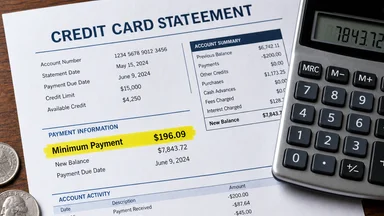
When your credit card statement arrives, the minimum payment is prominently displayed—often in bold, sometimes with a check box next to it. It looks like a convenience, a way to keep your account in good standing without forking over the full balance. But that convenience comes at a steep price. Paying only the minimum can extend your repayment period by years and inflate your total interest by 40% or more, turning a manageable debt into a long-term financial drain.
The Minimum Payment Trap: How Paying the Minimum Costs You 40% More
Most credit card issuers set the minimum payment at roughly 1% of your outstanding balance plus the accrued interest. With typical APRs ranging from 22% to 28% as of early 2025, that formula ensures that a large portion of your monthly payment goes toward interest rather than principal. The Consumer Financial Protection Bureau (CFPB) has noted that cardholders who pay only the minimum can take 15 to 20 years to clear a balance of a few thousand dollars.
Consider a $5,000 balance at a 24% APR. If you pay only the minimum—starting around $50 to $60 per month—the payoff timeline stretches to nearly 20 years. Over that period, total interest paid could exceed $7,000, meaning you repay roughly 140% of the original principal. That extra 40% above the principal is the hidden markup of minimum payments.
Issuers design minimum payments this way deliberately. By keeping you in revolving debt longer, they maximize interest income. A 2019 study by the Federal Reserve Bank of Boston found that consumers who pay only the minimum are among the most profitable customers for card issuers. The math is simple: the longer you carry a balance, the more interest accrues, and the issuer wins.
The Math Behind the 40% Markup
Let's walk through a concrete example. You have a $5,000 balance on a card with a 24% APR. The issuer's minimum payment is 1% of the balance plus interest. In month one, interest on $5,000 at 2% monthly (24% / 12) is $100. The 1% principal portion is $50, so your minimum payment is $150. After that payment, your new balance is $4,950. Next month, interest on $4,950 is $99, plus 1% principal of $49.50, for a minimum of $148.50. The payments decline slowly, but so does the principal.
Using an online payoff calculator, you'd find that at this rate, it takes 247 months—over 20 years—to pay off the debt. Total interest paid: roughly $7,100. That's 142% of the original $5,000. In other words, you pay an extra 42% beyond what you borrowed. Compare that to a personal loan for the same amount at, say, 10% APR over three years: total interest would be about $800, or 16% of principal.
The 40% markup is actually conservative. For a $10,000 balance at 28% APR, the total interest could exceed $15,000, a 150% markup. Some analysts at the National Consumer Law Center have described this effective rate as comparable to payday lending, though the structure differs. Payday loans carry triple-digit APRs over days or weeks, but credit card minimum payments can produce similar annualized costs when stretched over decades.
Who Benefits from Minimum Payments?
The credit card industry is built on revolving debt. According to the Federal Reserve, U.S. consumers carried over $1.2 trillion in revolving credit as of late 2024, the vast majority on credit cards. Interest payments alone generate roughly $30 billion annually for issuers, based on average APRs and outstanding balances. Late fees add another $14 billion, per a 2023 CFPB report. Minimum payments are the engine that keeps this machine running: they ensure steady interest income while keeping accounts open and active.
Beyond issuers, credit bureaus also benefit. Longer repayment histories mean more data points for scoring models, which can be sold to lenders. Debt collection firms buy charged-off balances for pennies on the dollar and profit from the remaining principal. Even some retailers benefit indirectly, as consumers with high revolving balances may be less likely to switch cards or close accounts.
There is a counterargument: minimum payments exist to help borrowers avoid default. For someone facing a temporary cash crunch, paying the minimum can prevent late fees, penalty APRs, and credit score damage. But the design encourages long-term reliance, not short-term relief. The CFPB's own research shows that consumers who pay only the minimum for six consecutive months are significantly more likely to remain in revolving debt for years.
The Psychological Trick: Anchoring on the Minimum
Credit card statements are engineered to guide behavior. The minimum payment appears first, often in a larger font, while the full balance is listed below. Behavioral economists call this anchoring: the first number you see becomes a reference point. Many cardholders subconsciously treat the minimum as the default or even the recommended amount. A 2018 study by the University of Chicago found that showing the minimum payment on statements led consumers to pay less on average than if the minimum was not displayed.
Auto-pay options reinforce this. If you set up automatic minimum payments, you may never see the full balance or realize how slowly the debt shrinks. Issuers profit from this inertia. In contrast, cardholders who pay in full each month—about 40% of users, according to a 2024 Fed survey—incur no interest. The divide between these two groups is stark: revolvers pay an average of $1,200 in annual interest, while transactors pay zero.
Buy-now-pay-later (BNPL) services use similar framing. They defer interest and show a low minimum installment, but if you miss a payment, deferred interest can be charged retroactively. The psychological trick is the same: make the immediate cost seem small, and the long-term cost becomes invisible.
How to Escape the Minimum-Payment Spiral
The most effective escape is to pay the full statement balance each month. If that's not feasible, aim to pay as much above the minimum as possible. Even an extra $20 per month on a $5,000 balance at 24% APR can cut the payoff time from 20 years to roughly 7 years and save thousands in interest. Use an online payoff calculator to see the impact of different extra payments.
For those with multiple cards, the snowball method—paying off the smallest balance first—or the avalanche method—targeting the highest APR first—can create momentum. Balance transfer cards offering 0% intro APR for 12 to 18 months can also help, but watch for transfer fees (typically 3% to 5% of the amount) and ensure you pay off the balance before the promo period ends. Personal loans from credit unions or online lenders may offer rates of 8% to 12% for good credit, which can replace high-interest card debt with a fixed repayment schedule.
Another option is to negotiate with your issuer. Some card companies offer hardship programs that reduce interest rates temporarily if you're struggling. It's not guaranteed, but it costs nothing to ask. Finally, consider using a debit card or cash for discretionary spending until your revolving balance is cleared. A related article on our site, The Personal Loan Prepayment Penalty That Wipes Out the Rate Discount, highlights another trap to watch for when refinancing.
Regulatory Blind Spots and Lender Tactics
Despite the CARD Act of 2009, which required issuers to include a warning about the cost of minimum payments on monthly statements, the disclosure is often easy to overlook. The warning appears in a small box with a generic payoff estimate based on a fixed payment—often assuming you pay only the minimum. Many consumers ignore it. The CFPB has proposed rules that would require issuers to show the dollar cost of paying only the minimum versus paying a higher amount, but as of mid-2025, those rules have not been finalized.
Lenders have also found ways to keep minimum payments low. Some cards calculate the minimum as a flat $25 to $35 regardless of balance, which can be less than 1% of a large balance. Others use tiered formulas that reduce the minimum after a certain period. These tactics make it even harder to pay down principal. The Schumer box, which discloses APR and fees, does not include a "time to repay" metric, leaving borrowers to do their own math.
Meanwhile, credit scoring models treat revolving utilization heavily. Carrying a high balance relative to your credit limit can lower your score, even if you make minimum payments on time. This creates a feedback loop: a lower score makes it harder to get better rates, locking you into high-interest cards. For more on how credit reporting can work against consumers, see The Credit Report Settlement Law That Removed Your Right to Dispute Errors.
Trade-offs and Alternative Perspectives
While paying the minimum is generally inadvisable, there are scenarios where it might be a strategic choice. For example, if you have a 0% introductory APR offer on purchases, paying the minimum during the promo period allows you to keep cash on hand for higher-return investments or emergency savings. However, this strategy requires discipline to pay off the balance before the promo ends; otherwise, deferred interest may be charged retroactively. Similarly, if you are prioritizing high-interest debt like payday loans or collection accounts, paying the minimum on credit cards could free up cash for those more urgent debts. But this trade-off must be calculated: the credit card interest continues to compound, and the long-term cost may outweigh the short-term benefit.
Another perspective comes from the credit card industry itself. Some issuers argue that minimum payments provide flexibility for consumers with irregular income. For gig workers or freelancers, a month with low earnings might necessitate a minimum payment. The key is to treat it as an exception, not a habit. Data from the Federal Reserve's Survey of Consumer Finances shows that households with volatile income are more likely to carry revolving balances, suggesting that minimum payments serve a temporary buffer function. However, the same data indicate that these households also tend to have higher debt-to-income ratios, making the minimum payment trap more dangerous for them.
There is also a behavioral argument: some consumers find it motivating to see the minimum payment decrease over time as they pay down debt. This can create a sense of progress, even if slow. For example, on a $3,000 balance at 22% APR, the minimum payment might drop from $80 to $60 over two years. While this is a small psychological win, the total interest paid over that period would be substantial. A better approach is to celebrate paying off the entire balance, not just the minimum.
Real-World Examples of the Minimum Payment Trap
Consider the case of Sarah, a teacher with a $4,200 balance on a store card at 26% APR. She paid the minimum of $85 per month for three years, thinking she was managing her debt. After 36 months, her balance had only dropped to $3,800, and she had paid over $1,000 in interest. If she had paid an extra $30 per month, she would have saved $800 in interest and paid off the card in five years instead of 15. Similarly, a small business owner named James used a credit card to cover a $7,500 equipment purchase at 24% APR. He paid the minimum for two years while focusing on other expenses, only to realize his balance had barely budged. By switching to a fixed payment of $250 per month, he cleared the debt in 3.5 years and saved $2,100 in interest.
These examples illustrate that even modest extra payments can dramatically change the outcome. The minimum payment is not a fixed destiny; it is a choice. By understanding the math and making intentional decisions, borrowers can avoid the 40% markup and take control of their financial future.
The Bottom Line for Borrowers
The minimum payment is not a feature designed for your benefit. It is a profit center for issuers, built on behavioral biases and regulatory gaps. The 40% extra interest estimate is conservative; many borrowers pay far more. The single most effective step is to pay more than the minimum, ideally the full balance. If that's not possible, automate a fixed amount above the minimum and treat it as a non-negotiable expense.
For those with good credit, refinancing to a personal loan or a 0% balance transfer card can provide a structured path out of debt. But the core lesson remains: the minimum payment is a trap, not a tool. Avoid it when you can, and escape it when you can't. For a broader view of how financial products can hide costs, read The Savings Account Yield That Funds the Bank’s Mortgage Lending Margin.
This article is for informational purposes only and does not constitute personalized financial advice. Consult a qualified professional for your specific situation.